

Vergleich
10 advantages of using 2D glasses versus virtual reality glasses for medical interventions
Why HappyMed relies on 2D video glasses in the healthcare sector — and what advantages this brings for patients and staff.
Background
VR glasses in medical use — what you should know

Virtual reality glasses, or VR glasses for short, are a popular tool in the entertainment industry. The glasses give the wearer the feeling of being in the middle of the action. However, some people experience undesirable effects when wearing VR glasses. This risk should be taken into account, especially in the case of medical interventions.

According to initial studies, every second user of VR glasses has already had a negative experience when wearing them; the older the patient, the higher the risk. This phenomenon is called VR disease and is described in published studies. VR glasses providers rarely discuss this topic.
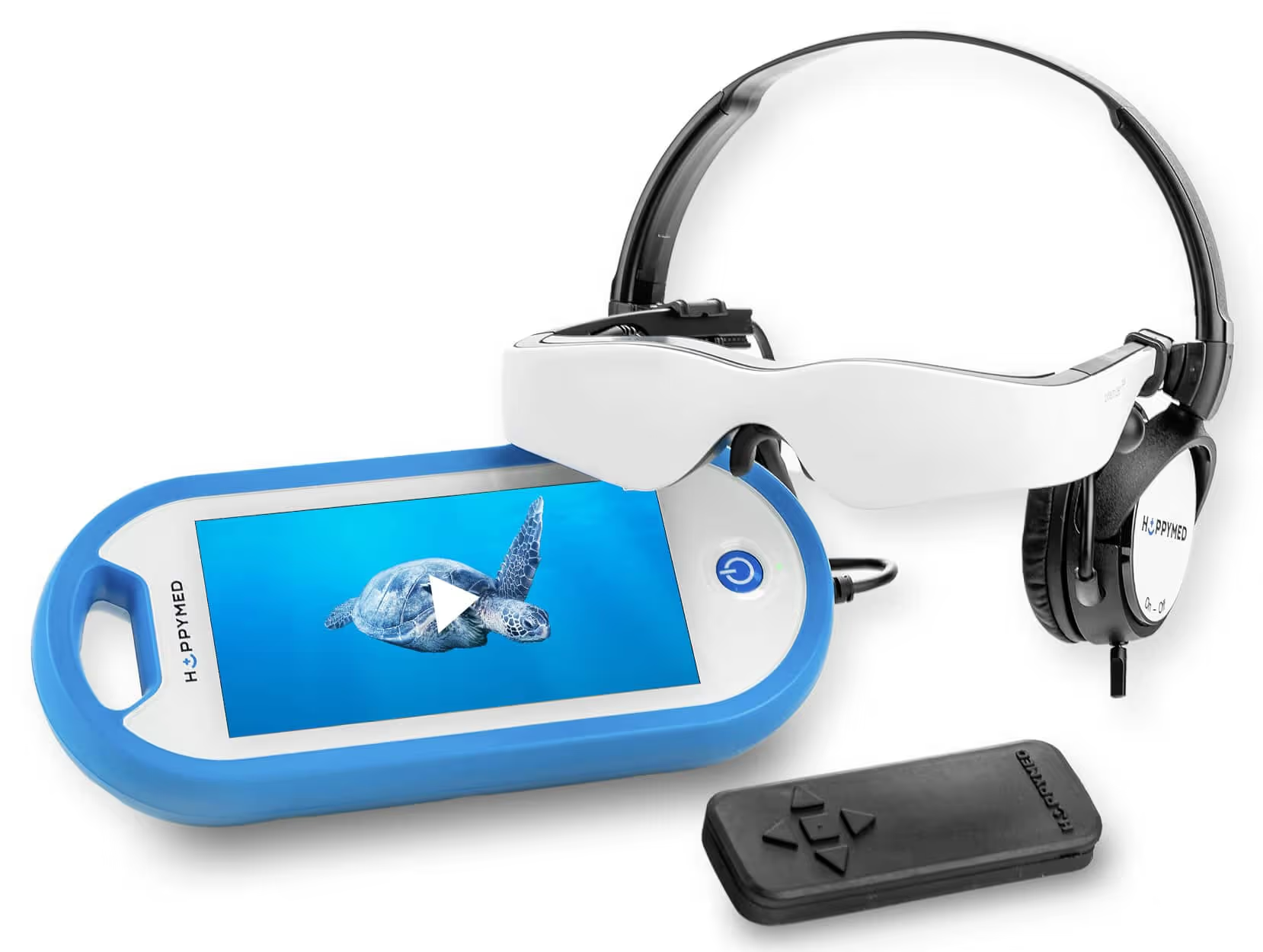
2D glasses allow the wearer a film experience just like in the cinema – without side effects and without discomfort. Because the film is displayed two-dimensionally on the screen, this guarantees the patient a completely natural cinema experience in "small format".
HappyMed video glasses are already used in over 300 clinics in Germany, Austria, and Switzerland.
Checklist
You should ask yourself the following questions before ordering a pair of VR glasses:

Wearing comfort
- Did older patients (60+) also get along well with the VR glasses?
- Are the VR glasses well-ventilated so the patient doesn't start sweating underneath them, even when worn for longer periods?
- Is wearing them still comfortable after more than 20 minutes, or does it become strenuous for the eyes?
- Does the initial enthusiasm last, or does it become tiring?
- Is a comfortable side or prone position also possible? (HappyMed offers a special positioning cushion)

Handling:
- Would colleagues who are less tech-savvy also use the VR glasses, or only a few?
- How accessible is the technology? Do older colleagues also enjoy using it?
- Can the VR glasses be cleaned well and quickly?
- If stretchable tension straps are used to position the glasses on the head, are they easy to clean?
- Can the VR glasses run on battery power alone, without mains power, for more than 2.5 hours?
- Do the VR glasses allow each side of the headphones to be switched on and off separately, to enable unobstructed communication with the patient?

Film content:
- Is there a good and varied selection of content for every mood of the patient?
- Is it regularly expanded with new genres?
- Men in particular often need more "action" to distract and relax them. Are there enough options for this?
- Is content offered for longer treatments (60+ minutes)?
- Is exciting content offered for all age groups?
- Do patients have the opportunity to find out about the film selection in advance?

Safety:
- Is the hardware genuinely certified as a medical device too, or only the software? (A liability issue for clinical staff.) Standard consumer electronics are usually used.
(Haftungsthema für Klinikpersonal) Meist wird normale Konsumentenelektronik verwendet.
Detailed comparison
Comparison: VR glasses vs. HappyMed video glasses
Here you can find out why HappyMed relies on 2D glasses in the health sector and which advantages are associated with them:
| Criterion | Virtual Reality Glasses | HappyMed Video Glasses |
|---|---|---|
| Product |

|
|
| Battery life | 2 hrs. | 10 hrs. |
| Certification as a medical device | Other providers claim that their product is a medical device. However, this is only partially true: the software is certified as a medical device, but the hardware itself is not. In such cases, safe use cannot be guaranteed, and there is a liability risk for the user. | With HappyMed, both the software and the hardware are certified as a Class 1 medical device. This means you, as the user, are legally protected when using it. |
| Weight | 500–900gincl. headphones | 150gincl. video glasses and headphones |
| In use |
|
|
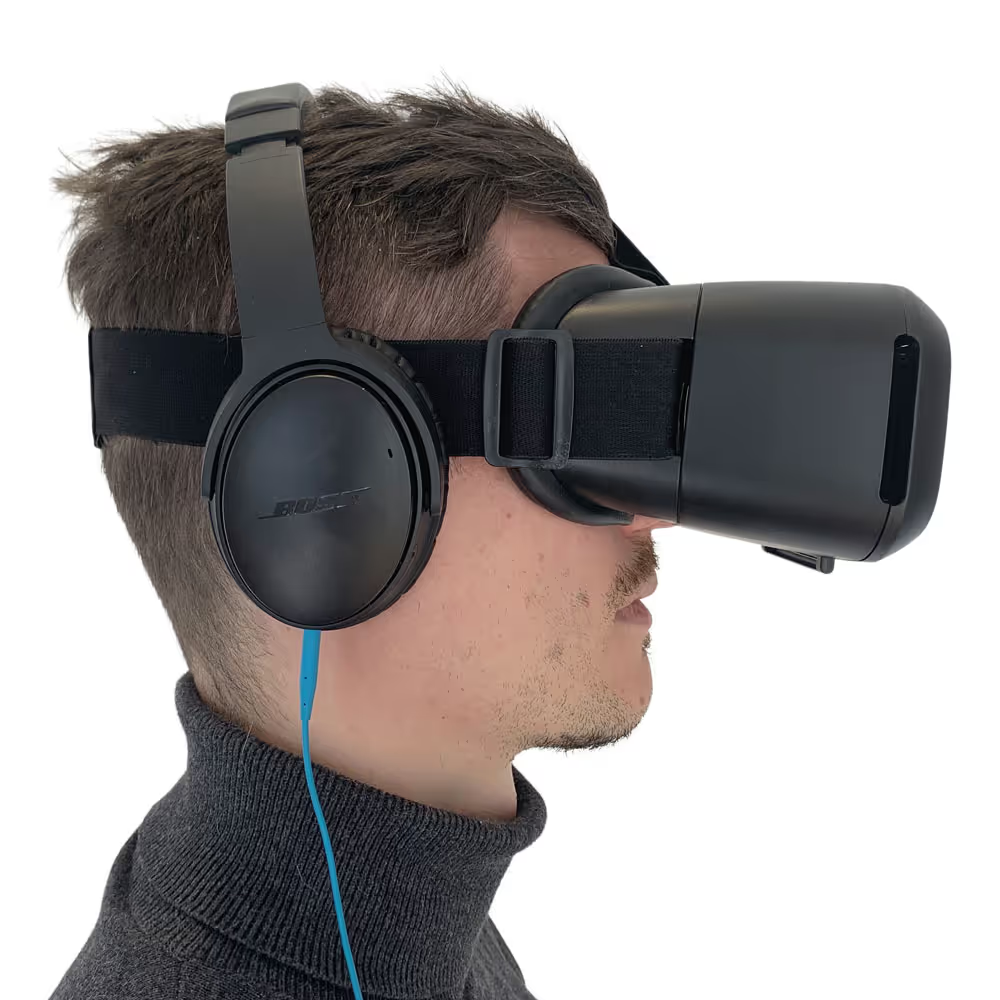
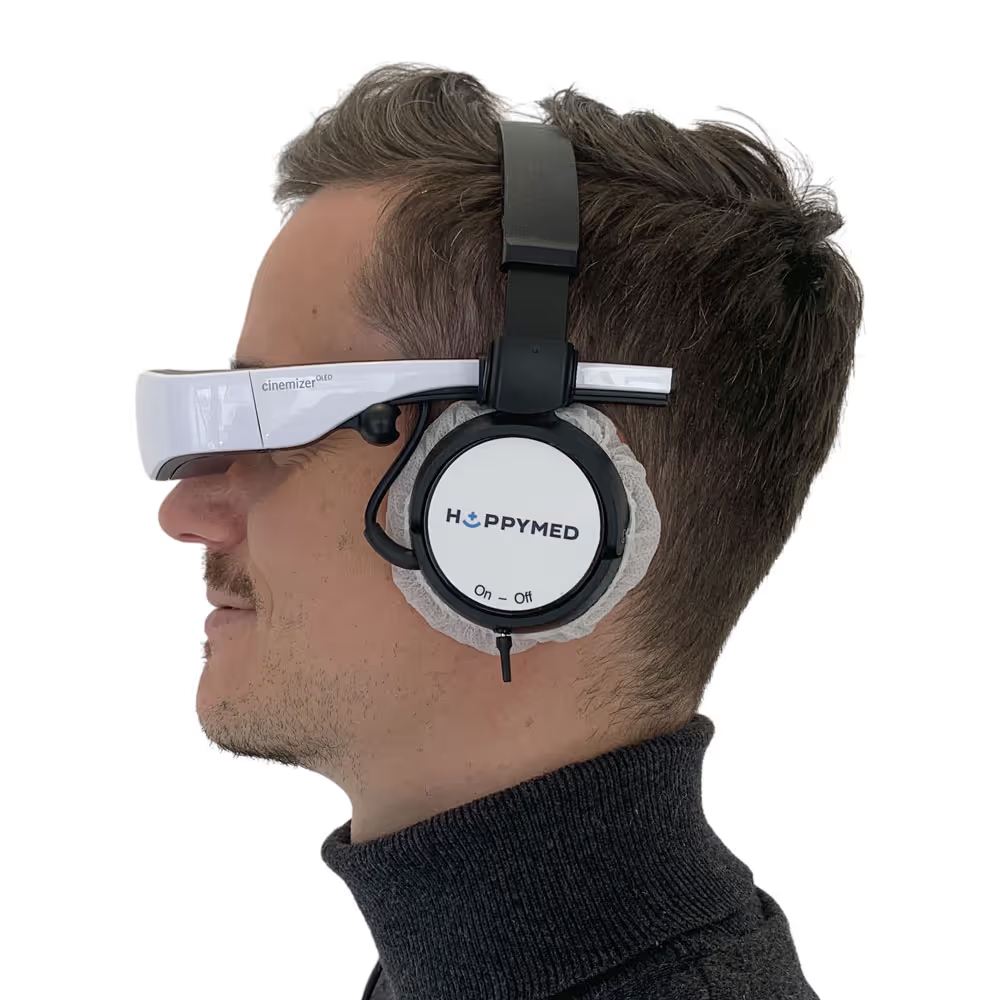
| Wearing comfort | Due to their high weight, VR glasses come with tension straps that are fastened tightly around the head. This creates pressure points, and wearing comfort drops significantly after 15 minutes. | The lightweight design allows for the use of glasses temples and ensures a comfortable fit for over 60 minutes. |
| Technology | The wearer of VR glasses is motivated to move their head in different directions. Head movements by the patient can impair or even prevent medical interventions. | When wearing the HappyMed video glasses, the patient sees the entire picture just like in a cinema. The complete cinema view allows the film to be watched in a fully relaxed position — with no unwanted head movements. |
| Possible side effects | Initial studies show that more than half of VR users have already experienced discomfort. The most common symptoms are similar to seasickness: malaise, headaches, nausea, fatigue, and apathy. People over 50 also appear to be more susceptible. | The HappyMed video glasses are classic two-dimensional (2D) video glasses. The occurrence of VR sickness or other side effects can be ruled out. |
| Visual acuity | Small changes in the distance between the VR glasses and the eye can quickly blur the image. Visual acuity cannot be adjusted separately for each eye. | For a sharp image, visual acuity can be adjusted separately for both eyes, making optimal use of the image quality. |
| Patient communication | The field of vision is 100% obscured. The anesthetist cannot see how the patient is doing, and the patient may be startled when touched. | The field of vision is covered by approx. 70%, so the patient can see something above or below the glasses. Medical staff are able to stay in contact with the patient at any time. |
| Lens condensation | Lenses fog up after a short time of use. A special spray must be applied before every use. | Thanks to good ventilation between the face and the video glasses, the lenses do not fog up. |
| Support | Direct hardware support may not be possible. | Hardware and software are produced directly by HappyMed GmbH. HappyMed provides corresponding support for both. |
| Content | Therapeutic content: hypnosis (therapy), 3D music therapy. | Video films for relaxation and distraction: relaxation journeys, nature documentaries, comedies, Hollywood films, classical concerts, and children's films. |
| Content duration | 2–90 min | 5–180 min |
| Material, hygiene & cleaning | The interior offers more surface area for hair and dandruff. Elastane tension straps absorb sweat and are difficult to clean thoroughly. | Compact design, easy to disinfect. Glasses temples made of 100% plastic do not absorb bodily fluids. Headphones are protected with hygienic single-use pads. |
| Country of manufacture | Belgium, Netherlands, France | Austria |
- https://en.wikipedia.org/wiki/Virtual_reality_sickness
- Andreas Sieß, Sandra Beuck, Matthias Wölfel: Virtual Reality – Quo Vadis? How to Address the Complete Audience of an Emerging Technology (Full Paper). 22. September 2017 (researchgate.net [abgerufen am 15. August 2018]).
- Andre Garcia, Carryl Baldwin, Matt Dworsky: Gender Differences in Simulator Sickness in Fixed- versus Rotating-Base Driving Simulator. In: Proceedings of the Human Factors and Ergonomics Society Annual Meeting. Band 54, Nr. 19, September 2010, ISSN 1541-9312, S. 1551–1555, doi:10.1177/154193121005401941 (sagepub.com [abgerufen am 11. Mai 2021]).
- Malte Klüver, Carolin Herrigel, Stephanie Preuß, Hans-Peter Schoener, Heiko Hecht: Comparing the Incidence of Simulator Sickness in Five Different Driving Simulators. 18. September 2015 (researchgate.net [abgerufen am 11. Mai 2021]).
Get to know the HappyMed video glasses better
Would you like to learn more about the HappyMed video glasses?
Find out about all the features, applications, and experience reports on our product page.
HappyMed has already been used over 300,000 times in 127 German clinics (including Sana, Asklepios, and Helios clinics). 92% of patients would like to use HappyMed again. Medical staff enjoy working with HappyMed in over 80% of cases, and in 45% of interventions, the HappyMed video glasses help reduce the use of sedatives, pain relievers, or anesthetics. In 73% of cases, medication could even be avoided entirely.
Try HappyMed free for 14 days