
Afraid of anaesthesia? Distracted and relaxed as a patient with the HappyMed Video Glasses
Afraid of anaesthesia: Will I wake up again?
For many people, the thought of being put to sleep with medication is frightening, especially when they are receiving anaesthesia for the first time. Yet according to the German Federal Association for Outpatient Surgery (Bundesverband für Ambulantes Operieren), the risk of not waking up from general anaesthesia today is very, very low (< 0.009%).

All these fears of anaesthesia are unnecessary!
Fortunately, with most knee and hip surgeries, you do not need to worry about this too much, because it is now common practice to perform them under regional anaesthesia, also known as spinal anaesthesia.
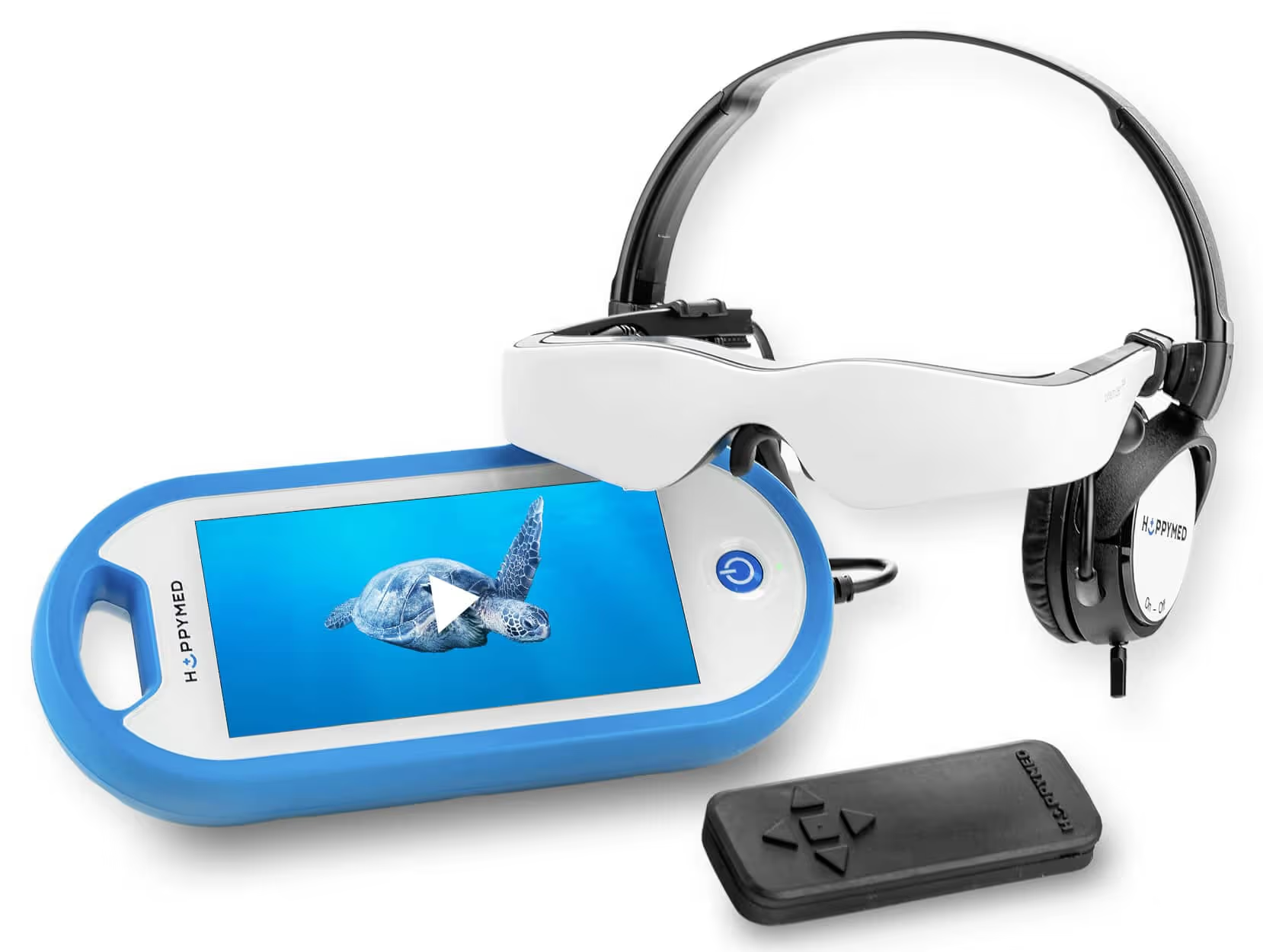
To make sure patients “don’t notice anything”, especially under regional anaesthesia, more than 300 Asklepios, Helios and Sana clinics and others use the HappyMed Video Glasses. One patient reports: “Thanks to the video glasses, I was able to distract myself with a documentary about the oceans and was much more relaxed.” Another patient says that a concert video captivated him so much while he was being prepared for anaesthesia that he almost forgot why he was in hospital at all.
Our HappyMed Video Glasses reduce anxiety, the need for sedatives and the risk of delirium (a short or long-term state of confusion).
Is your surgery coming up in a few days? We can send video glasses to any clinic free of charge. ZDF explains how our glasses accompany you during surgery:
Afraid of anaesthesia: loss of control and increased stress levels
In addition to the fear of not waking up, there is the fear of possible side effects such as nausea, dizziness or pain after anaesthesia. These fears, often referred to as “fear of losing control”, can lead to increased stress levels, which in turn affect body and mind and make it harder to prepare for the procedure.
The risk of people entering the operating room highly stressed because of their fear of anaesthesia is recognised in medicine as a serious problem. Studies show that patients who go into surgery feeling anxious often have higher levels of cortisol and other stress hormones in their bodies. These stress responses can have a negative effect on the healing process after surgery and slow down recovery.*

Fewer pills with the video glasses
With the HappyMed Video Glasses, fewer pills are needed to keep your stress levels in check. This is an immense advantage for patients who are afraid of the side effects of sedatives. Here are 3 excerpts from studies showing that audiovisual sedation reduces the amount of medication needed →
“Patients who received audiovisual distraction required significantly less opioid medication during urological procedures under spinal anaesthesia.”
Koch et al. (1998), The sedative and analgesic sparing effect of music, Anesthesiology, 89(2), 300–306.
“Audiovisual distraction with video glasses during endoscopic procedures significantly reduced the amount of propofol required.”
Lee et al. (2004), Can visual distraction decrease the dose of patient-controlled sedation required during colonoscopy?, Endoscopy, 36(3), 197–201.
“By distracting the children before and during the procedure with suitable films and music, the need for sedation was reduced by 91%.”
Etzel-Hardman & Jones (2009), Pediatric Distraction Techniques: Methods for Reducing the Need for Procedural Sedation During Computerized Tomography, Journal of Pediatric Nursing.
The HappyMed Video Glasses offer a calm path into anaesthesia
As explained in the ZDF video, surgeons often offer patients the option of changing their minds even during the surgery and opting for general anaesthesia. This means you can try the method that requires less medication, with regional anaesthesia and the HappyMed Video Glasses, and still have the option of switching later, if needed, to the option with potentially more side effects.
It is also common for doctors to give the patient a short update after each successful step of the surgery, so you are always informed about how the surgery is progressing.
Even the German Armed Forces (Bundeswehr) use 30 HappyMed Video Glasses in intensive care medicine and for transporting wounded soldiers back home. Even the bravest men and women of our country don’t say no to a little distraction.
Vorteile
HappyMed Videobrille und ihre Vorteile
Seit 2015 im Einsatz, erprobt und über 300.000 Mal in über 200 deutschen Kliniken angewendet
Zertifiziertes Medizinprodukt in der 3. Produktgeneration
Begeisterndes Kinoerlebnis mit über 80 Filmen: Große Auswahl an Spiel- und Naturfilmen sowie Dokumentationen. Damit ist für jeden etwas dabei- die Filme kann man vorab auf unserer Website auswählen
Schärfeneinstellung für jedes Auge separat - auch für Brillenträger geeignet
Lautstärke und Filmprogramm über Fernbedienung eigenständig anpassbar
Leichte Bauweise: angenehm zu tragen bei kurzen und längeren Hüft-OPs.
Wahlmöglichkeit, sich 100 % oder nur 80 % von der OP abzuschotten (mit zusätzlicher Augenabdeckung)
MEDIENANGEBOT
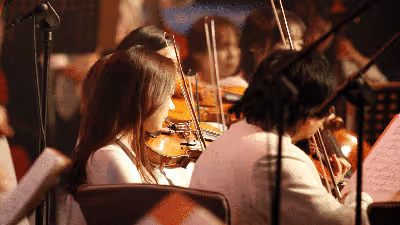
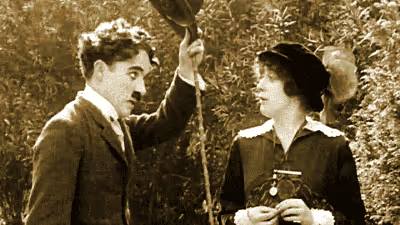
Mr. Bean schauen, Vivaldi hören oder nach Lappland reisen - über 80 Inhalte lenken optisch und akustisch ab
Das Programm bietet wahlweise Unterhaltung oder Entspannung für jedes Alter. Hier können Sie die aktuelle Filmliste als PDF downloaden.






How much time have you spent being afraid of 45 minutes?
The knee surgery in the ZDF video took only 45 minutes. How much mental energy, on the other hand, have you already spent worrying about the surgery? Knee and hip surgeries under regional anaesthesia often take no more than one to two hours, depending on the complexity of the procedure. This type of anaesthesia is preferred especially for older patients, to lower the risk of postoperative complications.
Thrombosis is one of the most common complications that can occur if you spend too much time in bed after surgery. Another serious health problem is the last thing you need. With regional anaesthesia, you get moving again more quickly and can soon enjoy everyday life again.
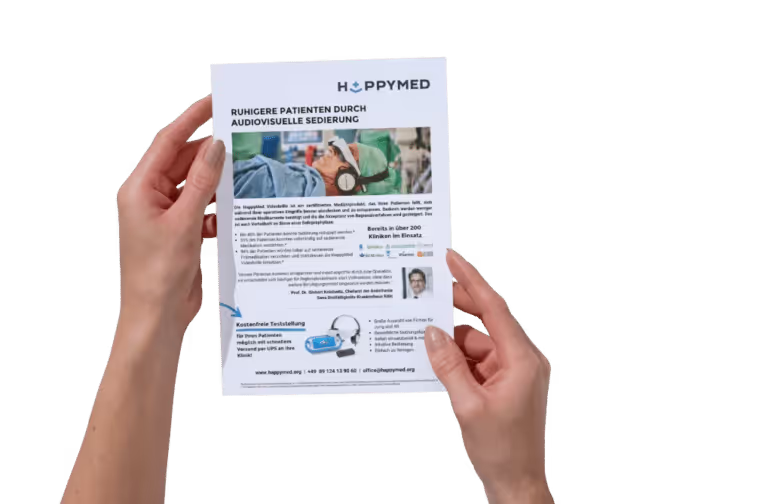
Für Ihren Anästhesisten beim Aufklärungsgespräch
Gehen Sie gut vorbereitet ins Anästhesie-Aufklärungsgespräch mit Ihrem Anästhesisten. Bringen Sie ihm den Aufklärungsbogen zu HappyMed mit, wenn Sie die HappyMed Videobrille für Ihre OP einsetzen möchten.
*American Society of Anesthesiologists. (2019). „The Impact of Preoperative Anxiety on Postoperative Recovery.“ Journal of Clinical Anesthesia, 55, 25-32. doi:10.1016/j.jclinane.2018.10.014
Mayo Clinic. (2020). „Effects of Preoperative Anxiety on Cortisol and Stress Hormone Levels in Surgery Patients.“ Mayo Clinic Proceedings, 95(2), 300-309. doi:10.1016/j.mayocp.2020.01.020
Wilson, J., Beard, D., & Murray, J. (2004). „Preoperative anxiety and cortisol levels.“ British Journal of Anaesthesia, 93(4), 520-524. doi:10.1093/bja/aeh237
Teststellung anfragen
Reduce your fear of anaesthesia now - we will send video glasses to any clinic for a free 14-day trial
Über 200 Asklepios-, Helios-, Sana-Kliniken und andere nutzen bereits die HappyMed Videobrille. Nennen Sie uns einfach den Namen Ihrer Klinik und vielleicht können wir Sie direkt beruhigen, denn Ihre Klinik nutzt schon HappyMed Videobrillen. Falls nicht, tun wir alles in unser Machtstehende, den Operateuren eine Brille zukommen zulassen, selbst wenn Ihre OP in wenigen Tagen ansteht.
Wenn die Klinik erstmalig ein Gerät testet, dann übermitteln wir Ihnen als kleines Dankeschön für Ihre Empfehlung einen 25 € Amazon Gutschein. Lassen Sie sich entführen nach Lappland oder auf die Malediven – anstatt ins Land der Angst!