
Delirium prevention with the HappyMed Video Glasses

What is perioperative delirium?
It is a state of confusion accompanied by cognitive dysfunction and/or spatial disorientation. Studies show that up to 50% of older patients can develop delirium after surgery. Dementia patients are particularly prone to developing delirium.*
Yet delirium is often not taken seriously enough, and a validated delirium screening is not always carried out, which can lead to undetected long-term consequences.
Delirium prevention: why is it so important?
In addition to short-term effects such as increased restlessness, sleep disturbances and confusion, delirium can also result in long-term memory problems or even permanent impairment of cognitive abilities.
Furthermore, delirium is associated with a longer hospital stay and places an additional burden on both the patient and the healthcare system. The cost of an additional day in intensive care or hospital for a delirium patient is around €1,200. With an additional length of stay of 4.2 days in hospital, this can quickly add up.**
But it is not only older people who struggle with delirium. Preoperative anxiety poses a particularly high risk of delirium in children. Studies show that anxious children develop delirious states eight times more often than relaxed children. After surgery, these children also need pain medication more often and suffer more from anxiety and sleep disturbances.***
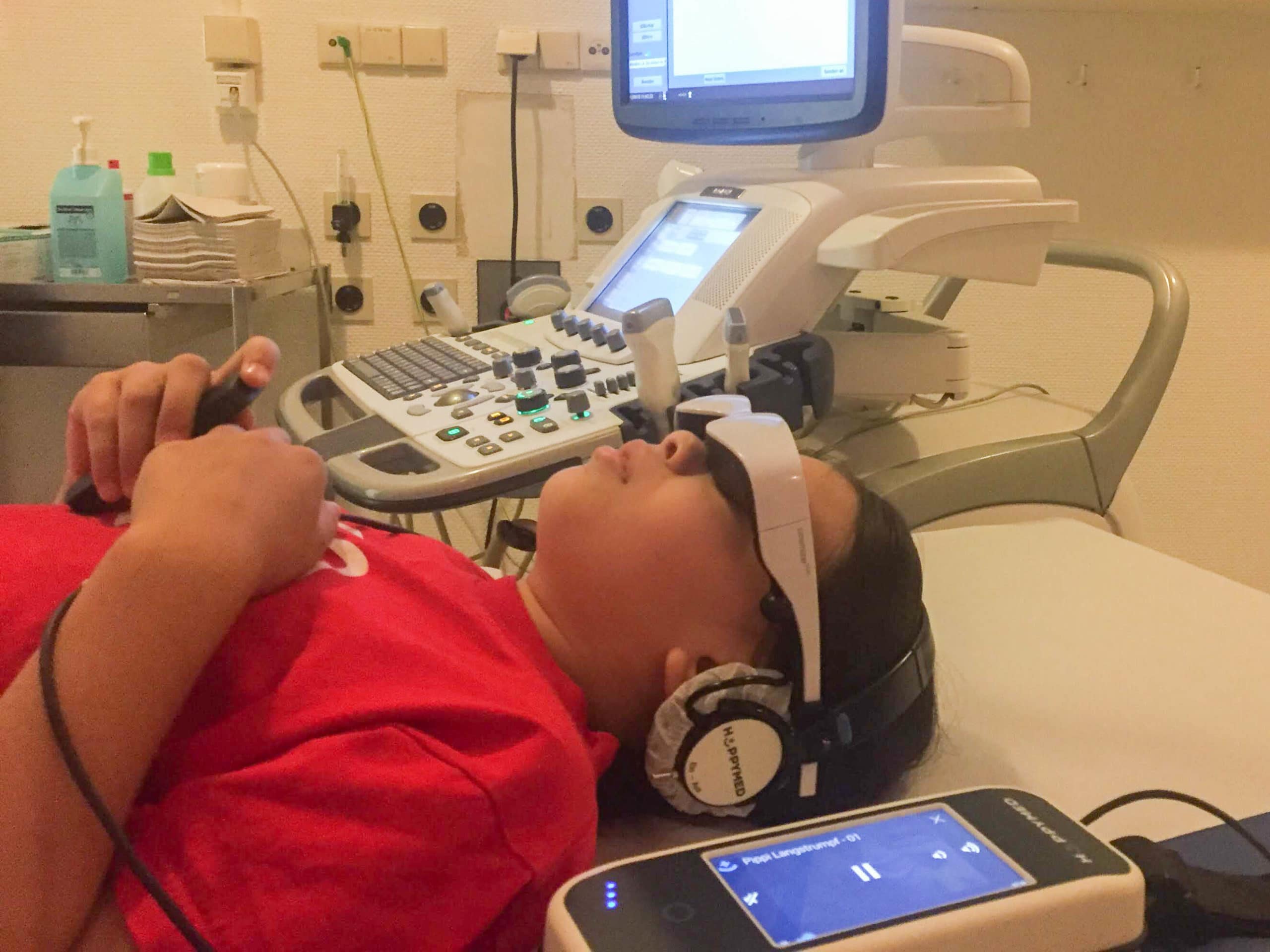
Delirium prevention in the 21st century is done with the HappyMed Video Glasses
The HappyMed Video Glasses offer non-drug audiovisual distraction that reduces stress and anxiety during surgery under regional anaesthesia, thereby lowering the risk of delirium. The glasses allow patients to enjoy films, documentaries or music, which directs their attention away from the surgery and towards positive stimuli.
HappyMed has conducted more than 40 studies with hospitals, showing that visual and auditory distraction can play a role in reducing anxiety and cognitive disorders, which lowers the likelihood of delirium after anaesthesia. The studies were carried out in a wide range of medical specialties, such as orthopaedics, intensive care medicine, cardiology, dentistry, paediatrics, obstetrics, urology and gynaecology.
Another particular advantage of the HappyMed Video Glasses is that fewer or even no sedatives often need to be used, which leads to faster recovery and a shorter hospital stay. It also eliminates the uncertainty about how new medications prescribed in hospital interact with existing medications that a patient may have to take every day anyway.
Vorteile
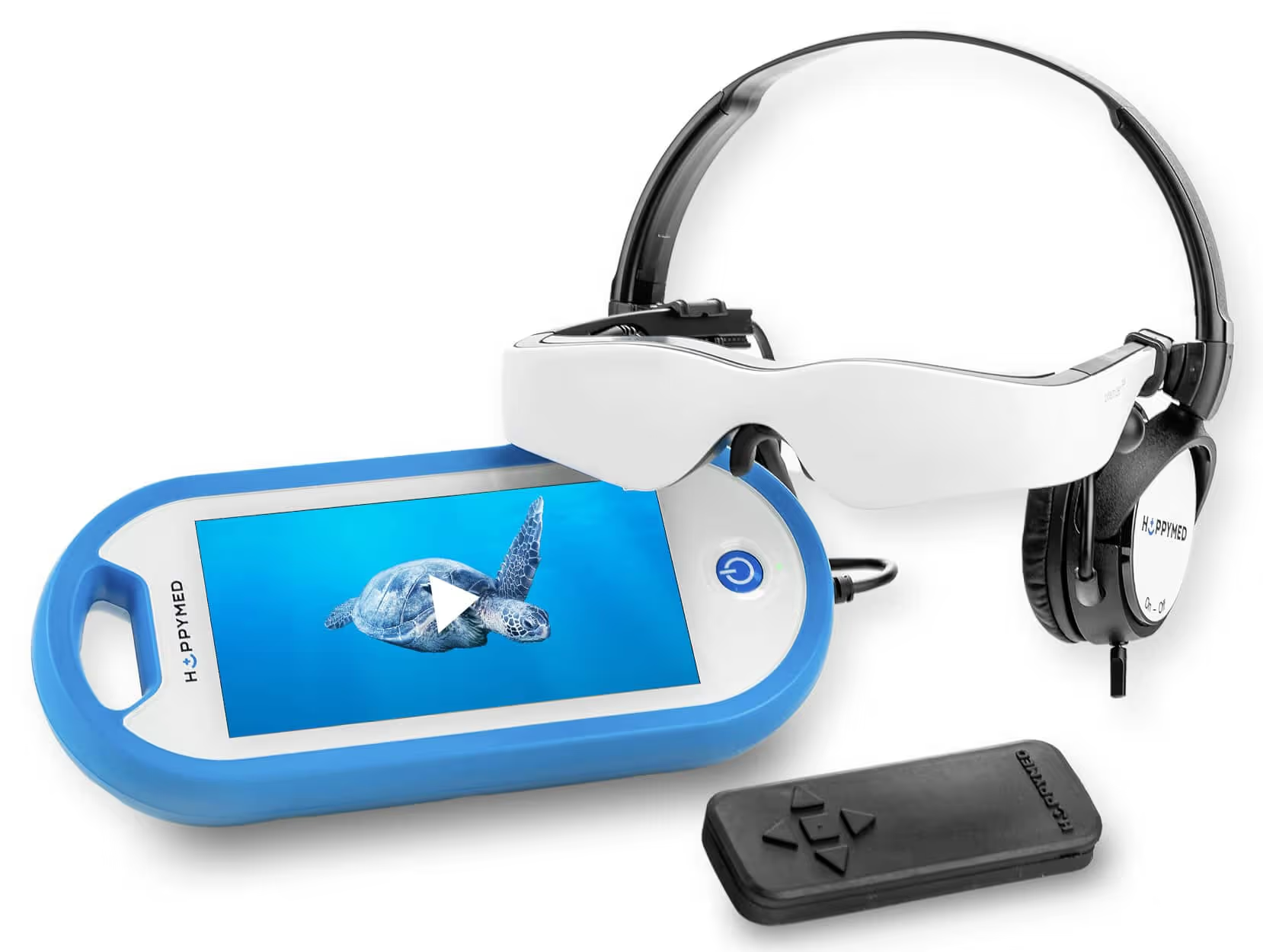
HappyMed Videobrille und ihre Vorteile
Seit 2015 im Einsatz, erprobt und über 300.000 Mal in über 200 deutschen Kliniken angewendet
Zertifiziertes Medizinprodukt in der 3. Produktgeneration
Begeisterndes Kinoerlebnis mit über 80 Filmen: Große Auswahl an Spiel- und Naturfilmen sowie Dokumentationen. Damit ist für jeden etwas dabei- die Filme kann man vorab auf unserer Website auswählen
Schärfeneinstellung für jedes Auge separat - auch für Brillenträger geeignet
Lautstärke und Filmprogramm über Fernbedienung eigenständig anpassbar
Leichte Bauweise: angenehm zu tragen bei kurzen und längeren Hüft-OPs.
Wahlmöglichkeit, sich 100 % oder nur 80 % von der OP abzuschotten (mit zusätzlicher Augenabdeckung)
MEDIENANGEBOT
Mr. Bean schauen, Vivaldi hören oder nach Lappland reisen - über 80 Inhalte lenken optisch und akustisch ab
Das Programm bietet wahlweise Unterhaltung oder Entspannung für jedes Alter. Hier können Sie die aktuelle Filmliste als PDF downloaden.







The HappyMed Video Glasses are not virtual reality glasses
Virtual reality headsets are very popular in the entertainment industry, but they bring a number of challenges when used medically in the operating room. To fully perceive their surroundings, the patient would have to turn and move their head, which is not ideal in the operating room.
In addition, wearing VR headsets can cause dizziness in some patients. Another disadvantage lies in the focus on visual perception: the patient is only distracted visually, not acoustically, so they continue to hear the ambient noise, which can impair the calming effect. For these reasons, HappyMed uses classic video glasses with integrated headphones. Give your patients a surgery with the following benefits →
- Reduction of anxiety and stress: The audiovisual distraction during surgery calms patients and lowers the risk of delirium occurring.
- Lower healthcare costs: Considerable costs can be saved by avoiding prolonged stays caused by delirium and the additional treatments associated with them.
- Reduced need for sedatives: Less medication means fewer side effects and faster recovery.
- Improved patient comfort: Patients find the surgery less frightening and feel more comfortable overall.
Galileo shows in 60 seconds how our glasses have a calming effect during surgery
*
Aldecoa, C., et al. (2017). „European Delirium Guidelines.“ European Journal of Anaesthesiology, 34(4), 192-204.
Inouye, S. K., et al. (2014). „Delirium in Elderly People.“ The Lancet, 383(9920), 911-922.
Marcantonio, E. R. (2017). „Delirium in Hospitalized Older Adults.“ New England Journal of Medicine, 377(15), 1456-1466.
Rudolph, J. L., et al. (2008). „Delirium: An Independent Predictor of Functional Decline After Cardiac Surgery.“ Journal of the American Geriatrics Society, 56(7), 1191-1197.
**
Weinrebe, W., Johannsdottir, E., Karaman, M., & Füsgen, I. (2016). „What does delirium cost? An economic evaluation of hyperactive delirium.“ International Journal of Geriatric Psychiatry, 31(6), 597–605.
***
Kain, Z. N., Mayes, L. C., Caldwell-Andrews, A. A., Karas, D. E., & McClain, B. C. (2006). Preoperative anxiety, postoperative pain, and behavioral recovery in young children undergoing surgery. Pediatrics, 118(2), 651–658.
Teststellung anfragen
Test the HappyMed Video Glasses for delirium prevention free of charge for 14 days
Über 200 Asklepios-, Helios-, Sana-Kliniken und andere nutzen bereits die HappyMed Videobrille. Nennen Sie uns einfach den Namen Ihrer Klinik und vielleicht können wir Sie direkt beruhigen, denn Ihre Klinik nutzt schon HappyMed Videobrillen. Falls nicht, tun wir alles in unser Machtstehende, den Operateuren eine Brille zukommen zulassen, selbst wenn Ihre OP in wenigen Tagen ansteht.
Wenn die Klinik erstmalig ein Gerät testet, dann übermitteln wir Ihnen als kleines Dankeschön für Ihre Empfehlung einen 25 € Amazon Gutschein. Lassen Sie sich entführen nach Lappland oder auf die Malediven – anstatt ins Land der Angst!